
What modular bench sections are made for
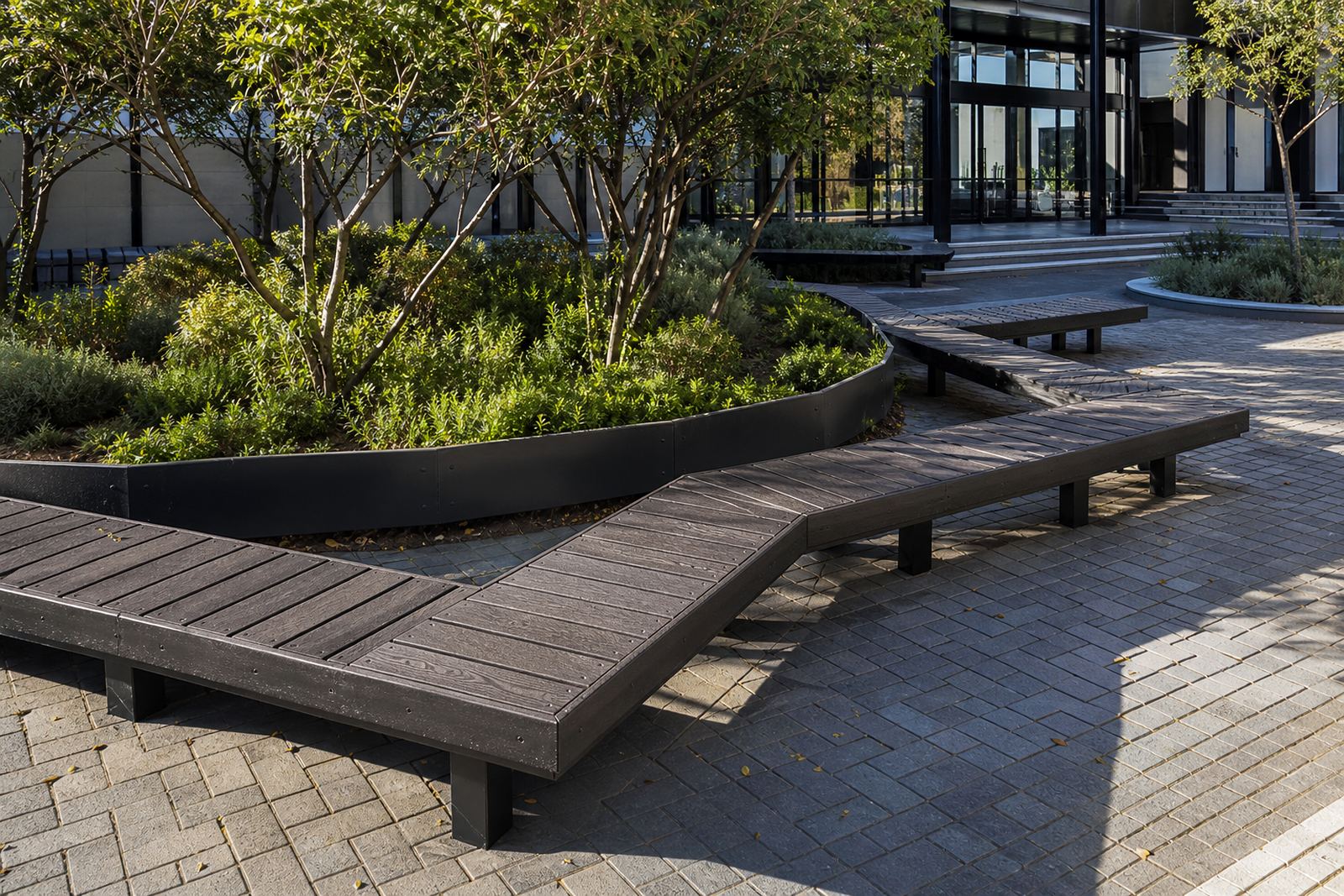
Modular benches are built as separate seating sections that can be joined into a straight run, an L shape, a corner grouping or a longer public seating line. That makes them useful when the seating plan may change later, or when a project has to be done in stages as funding, access or site works allow. Instead of committing to one fixed bench, you can start with a few sections and add more as the space grows.
For schools, visitor areas, shared courtyards, apartment gardens, retail forecourts and municipal spaces, this approach gives good control over layout. It also helps on sites with uneven paving, stepped areas or narrow access, since each section can be handled and positioned separately. The recycled plastic lumber holds up well in sun, rain and coastal moisture, and it does not need the same regular sealing or painting as timber.
Sizes, module options and layout choices
Modular bench work starts with the site size and how people will use the seat. Sections can be specified as individual modules, with lengths and arrangements planned to suit straight walls, edges, planters or open seating pockets. On some projects the bench is kept low and simple, while on others the seat back, arm rests and end returns are added for comfort and structure.
- Straight seating runs for passages, courtyards and waiting areas
- Corner and L shaped layouts for planted areas or shared outdoor rooms
- Single sections for phased installation and future expansion
- With or without backrests, depending on comfort and sightlines
- Optional arm rests and end caps for a neater finish
- Colour and finish choices that suit the surrounding paving, walls or landscape
Because every site has its own spacing, the best result comes from measuring the area before ordering. That helps avoid tight clearances, awkward joins or benches that sit too close to walkways. On windy coastal sites in places like Cape Town, Strand or Durban, we also look at how the bench will sit relative to exposure, drainage and moving sand or spray.
Where modular benches suit best
These benches are practical in places where outdoor seating needs to last and stay neat with limited upkeep. They suit parks, schools, office courtyards, apartment complexes, hospitality terraces, walkways, public gardens and commercial entrances. In George and Stellenbosch they work well in landscaped spaces that need a natural look without the upkeep of stained timber. In Johannesburg and Paarl they are often used where summer sun and regular use make maintenance a concern.
Recycled plastic lumber is a good choice for areas that see frequent cleaning, damp conditions or exposure to sprinklers. It does not split like some timber products and it copes well with everyday use, though correct design and installation still matter. If the bench is being used in a high traffic environment, the site plan should allow for access, cleaning routes and enough space for people to sit without blocking movement.
- Good for outdoor waiting areas and communal seating
- Useful in education, retail and hospitality settings
- Suitable for coastal towns with moisture and salt in the air
- Works in phased projects where not all seating is installed at once
Installation, fixing and site requirements
Modular benches do not need power or gas for normal use. For installation, the main requirements are a level, stable base and proper fixing points where needed. Depending on the site, the bench can be anchored to concrete, paving or another prepared surface. If the ground is uneven, the layout should be adjusted before fitment so the modules line up properly and do not rock or twist under load.
Installation is usually simpler when the modules are delivered with the site plan already agreed. That saves time on the day and reduces rework. For public areas and commercial sites, it is also worth checking local access rules, work hours and any requirements from building management or municipal control before installation begins. In some cases, bench placement needs to fit around drainage channels, service covers or planting zones, so the final layout should be checked carefully.
We can assist with site measures, layout planning, delivery coordination and bench installation, plus edge finishing where the seating meets paving or planting borders. If a project needs the seating phased over time, the first modules can be set out so later sections join cleanly without obvious gaps or mismatched heights.
Care, cleaning and refurbishment over time
Modular benches are chosen because they are straightforward to keep in good condition. Routine cleaning with water and a mild detergent is usually enough for dust, bird droppings and general outdoor dirt. In coastal areas, regular rinsing helps remove salt build up. In busy centres like Bellville or Somerset West, a simple maintenance routine keeps the seating looking presentable without constant sanding, sealing or repainting.
If a section gets damaged, modular seating is easier to service than a fixed one piece bench because individual components can often be replaced. That can include slats, seat sections, fixings or end components. Refurbishment is also an option when the site wants to extend the life of the seating rather than replace it entirely. Good care advice starts with the first installation, because the right base, spacing and fixing method all affect how the bench performs over time.
- Wash with mild detergent and water
- Rinse salt and grime regularly in coastal areas
- Check fixings after heavy use or seasonal weather changes
- Replace damaged components rather than removing the full bench where possible
What to confirm before placing an order
Before ordering modular benches, it helps to confirm the exact site dimensions, the number of people the seating should serve, and whether the layout needs to be changed later. You should also decide whether the bench needs a backrest, arm rests, a low profile or a more formal public seating look. For trade buyers, the delivery access, unloading point and installation sequence should be clear before production starts.
It is also worth checking the surface the bench will sit on. A level concrete slab, properly laid paving or another stable base gives the best result. If the site is on a slope, near a drain or close to a boundary wall, those details should be noted early. That avoids delays and helps with material quoting. If the seating forms part of a broader outdoor upgrade, matching it with decking, planters or acoustic screening can keep the space consistent and practical.
Our team in Paarden Eiland supports projects across Cape Town, Stellenbosch, George, Johannesburg, Durban, Paarl, Somerset West and Bellville, with delivery arranged nationwide. For modular benches, clear measurements and a simple site sketch usually make the ordering process much smoother, especially when the installation has to happen in stages or around other trades on site.
Key facts
| Material | Recycled plastic lumber for outdoor seating sections |
|---|---|
| Configuration | Straight runs, corners, L shapes and phased seating layouts |
| Typical options | With or without backrest, arm rests and end returns |
| Fixing method | Anchored to a prepared concrete or paved base where required |
| Maintenance | Low maintenance, with routine cleaning and occasional component replacement |
| Service area | From Paarden Eiland, Cape Town to sites across South Africa |