
Why a Small Balcony Needs a Smarter Surface
A compact balcony has to earn its keep. In Cape Town and other coastal towns, that means dealing with salt air, damp mornings, strong sun, and the odd spell of wind that pushes loose items around. Recycled plastic lumber decking is often chosen for these spaces because it handles moisture well and does not splinter like many timber options can over time.
For flats, townhouses, and upper level units, the surface underfoot matters just as much as the railings or the furniture. A neat deck finish can make a narrow balcony feel more organised and easier to clean. It also helps create a proper walking area, so the space feels less like an outside ledge and more like part of the home.
- Works well in exposed coastal conditions
- Useful where low maintenance is a priority
- Can suit both private homes and shared residential units
Layout Ideas That Make Narrow Balconies Feel Bigger
Good balcony planning starts with the footprint. On a small space, the goal is not to fit everything in, but to choose the right zones. A deck can be laid to define a sitting area, a plant line along the wall, or a clear strip for walking and opening doors without fuss. Even a modest change in board direction can make the balcony feel longer or wider depending on the shape.
It also helps to keep the edge details tidy. Clean finishing around columns, thresholds, and drainage points makes the whole space look considered, especially in older buildings where the balcony slab may not be perfectly square. In many Johannesburg and Durban apartments, residents want something that looks smart but does not demand constant sanding, sealing, or repainting.
- Run boards lengthwise to draw the eye outward
- Keep access to doors, drains, and service points clear
- Allow room for a fold-up table or slim seating if needed
- Use trim and edge finishing to keep the perimeter neat
Why Recycled Plastic Lumber Suits Coastal and Urban Living
Recycled plastic lumber is made for hard use. It does not absorb water in the same way as many natural materials, so it is often a sensible choice where balconies see regular rain, sea spray, or cleaning with a hose. In places like Stellenbosch and Paarl, where the weather swings between dry heat and winter wet, that kind of stability is useful.
It is also a practical fit for busy households and rental units. Once installed, the surface usually needs only basic washing and inspection. That makes it easier to manage on buildings where residents do not want ongoing upkeep or repeated repairs. For landlords and body corporates, the appeal is often the same: a cleaner look, fewer maintenance calls, and material that can cope with everyday use.
Because balconies are often small, the material choice has to be sensible as well as neat. A product that suits exterior conditions, holds its shape, and stays serviceable with minimal attention is easier to live with than one that looks good for a season and then starts to age badly.
Safe, Clean Finishing on Upper Floors
Balcony work is not just about appearance. On upper floors, careful installation matters for safety, water movement, and drainage. The substructure needs to suit the site, and the finished level must work with the door threshold, balustrade, and fall of the slab. If the surface is too high, doors can bind or water can sit where it should move off the balcony.
In coastal Cape Town blocks and older walk-up flats, there can be extra attention needed around waterproofing and edge conditions. A proper site measure helps identify these details before work begins. That reduces the chance of awkward joins or last-minute adjustments, and it gives a clearer picture of how the finished deck will meet the existing building.
- Check balcony falls before any deck layout is agreed
- Leave drainage points open and accessible
- Keep the finish level with door movement in mind
- Use sensible edge details where the balcony meets walls or steps
A Practical Example from a Cape Town Balcony
Consider a small apartment balcony in Paarden Eiland, where sea air, dust, and daily foot traffic all affect the surface. The owner wants a usable space for two chairs, a planter box, and a safe path to the clothes rack. The existing slab is plain and uneven at the edge, so the balcony never feels fully finished.
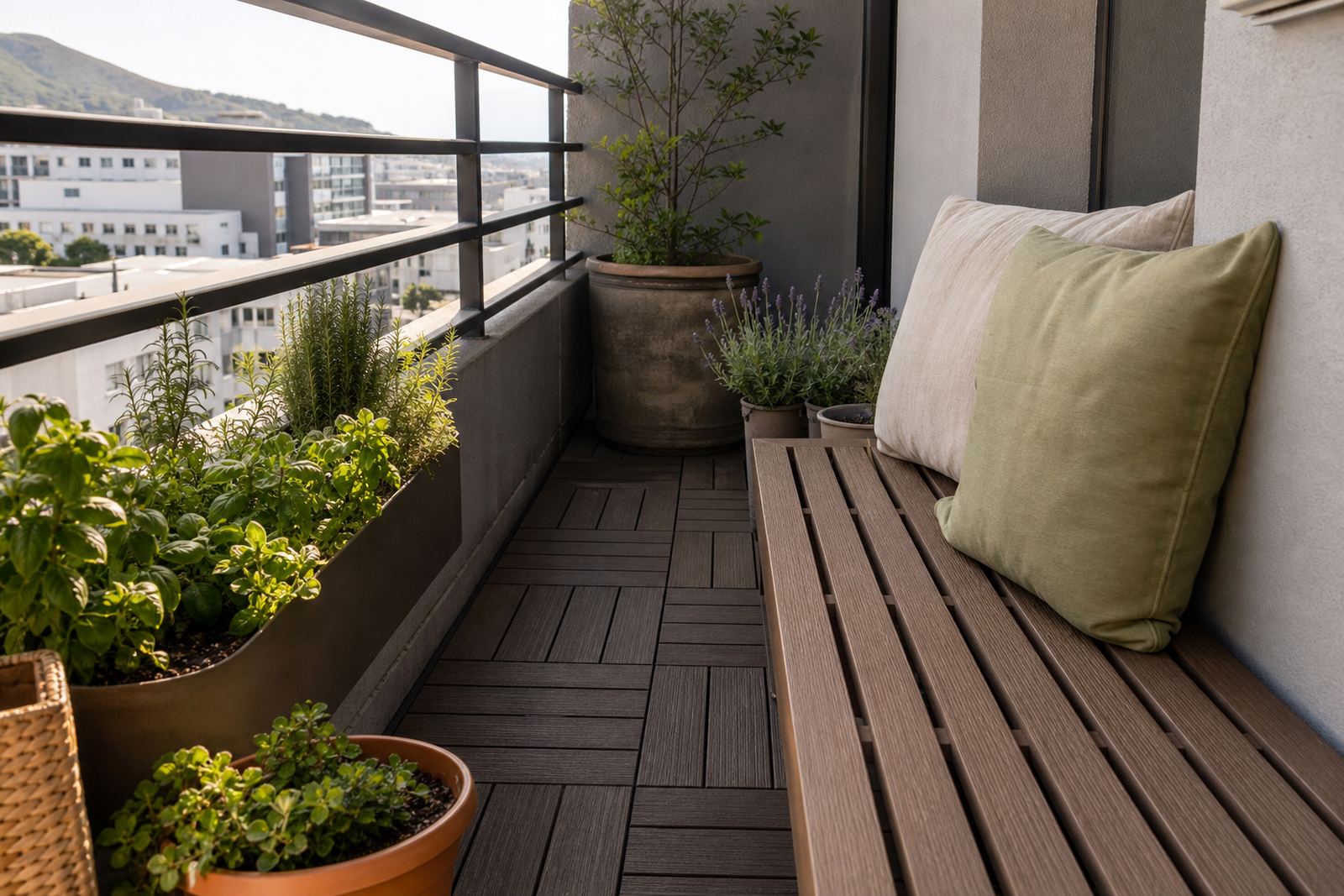
After a site measure, the layout is planned to keep the door swing clear and preserve drainage. The deck boards are arranged to make the balcony feel wider, while the perimeter is finished neatly to reduce visible cut ends. A simple bench can be added along one side, giving seating without taking up the middle of the space. The result is not oversized or fussy, just more comfortable and easier to use every day.
This kind of project is common across Cape Town, Stellenbosch, George, Johannesburg and Durban, where owners often want to improve a compact area without turning it into a full renovation. A well-planned small deck can make the balcony more inviting from the first cup of tea in the morning to the last bit of fresh air at night.
Bench Additions That Fit Tight Spaces
A compact balcony does not need bulky furniture to feel complete. A built-in or freestanding bench made from recycled plastic lumber can give useful seating without crowding the floor. It is a good choice where residents want something tidy, durable, and easy to wipe down after rain or dust. On shared terraces, a bench can also create a clear edge to the seating zone while leaving the centre open.
For small spaces, simple forms usually work best. Straight lines, low profiles, and careful placement near a wall or balustrade can keep the balcony from feeling cramped. In a humid climate, it also helps that the material is not reliant on regular painting or sealing, which is useful for homeowners who do not want another task on the maintenance list.
- Choose bench sizes that suit the width of the balcony
- Place seating where it does not block drainage or access
- Consider a low bench for narrow spaces
- Use the same material family for a consistent finish
Planning, Delivery, and Ongoing Care Across South Africa
From Paarden Eiland, projects are coordinated for homes and commercial spaces across South Africa, including Cape Town, Stellenbosch, George, Johannesburg, Durban, Paarl, Somerset West and Bellville. That can include site measures, layout planning, material quoting, delivery coordination, deck installation, bench installation, edge finishing, refurbishment, component replacement, care advice, and trade support.
Compact balcony decks are often straightforward, but they still benefit from proper planning. A small misjudgement on a balcony can affect water run-off, door clearance, or furniture placement. With the right measurements and a practical layout, the finished space feels useful every day instead of just looking good in photos. For body corporates, landlords, and homeowners alike, that is usually the point.
For balcony projects, clients usually start through the enquiry form on the contact page. From there, the details can be worked through clearly, with attention to the site conditions and the final use of the space.