Why benches matter near play equipment
A good playground needs more than swings, slides and open ground. Parents, caregivers and teachers need a place to pause while still keeping a clear view of the children, and that changes how the whole space works. When seating is placed well, adults do not cluster at the entrance or stand in narrow walkways. They can sit, talk, and supervise without blocking movement around the play area.
Recycled plastic lumber benches suit this kind of setting because they hold up well in busy spaces. In coastal towns like Cape Town, Somerset West and George, they cope better with damp air than many timber options and they do not need the same level of sanding, sealing or repainting. For schools, crèches, estates, parks and community centres, that means less upkeep and fewer interruptions.
Choosing the right bench position
Bench placement should start with sight lines. Adults need to see the whole play zone without having to stand up every few minutes. In family spaces, it often helps to set benches at the edge of the activity area, angled slightly toward the equipment rather than facing away from it. That way supervision stays easy while the seating remains comfortable.
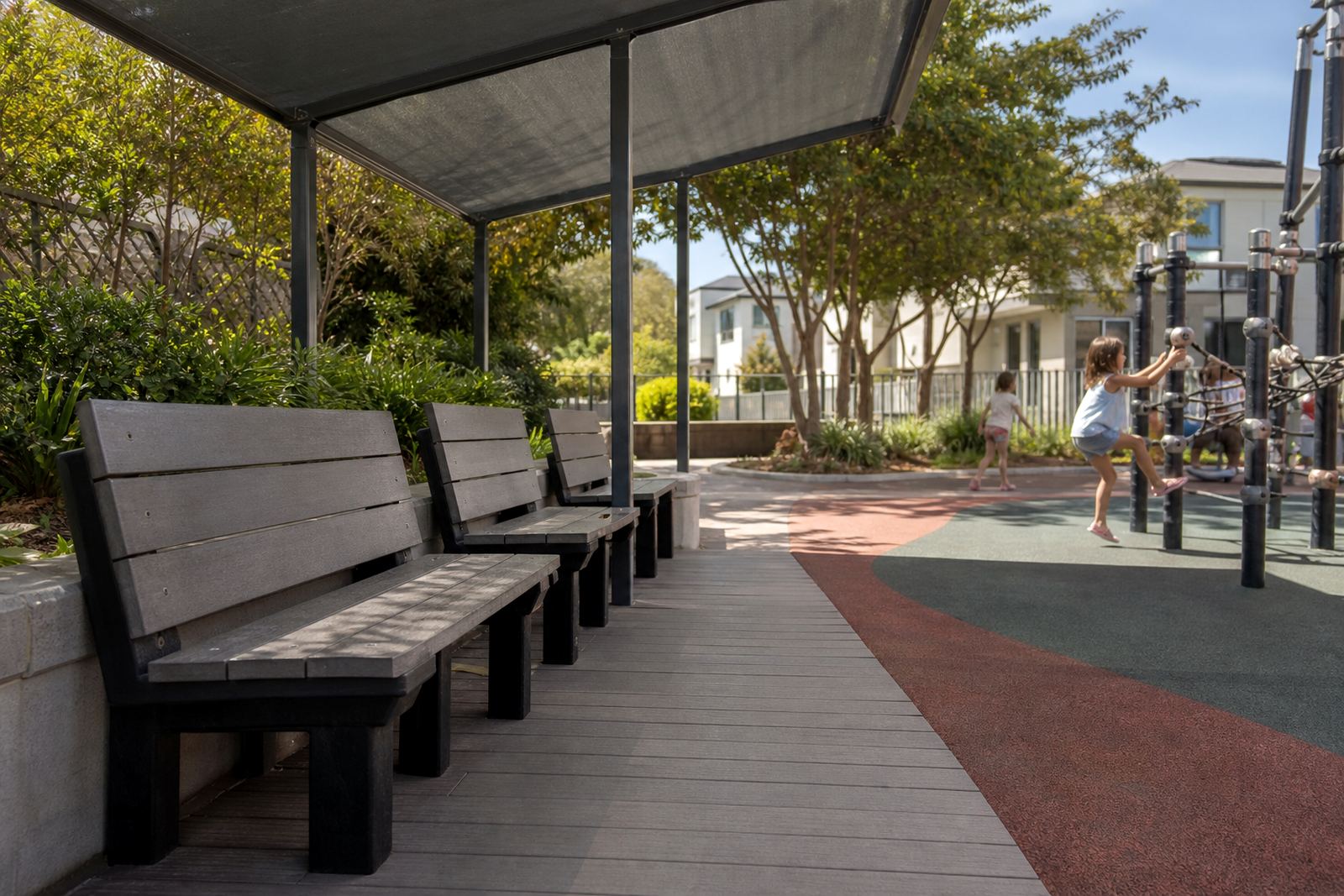
It is also worth thinking about foot traffic. Benches should not sit directly where children run, cut corners, or stop suddenly. Leave enough room for strollers, prams and wheelchairs to move past. In municipal areas, keep clear of fire paths, access gates and maintenance routes. In windy spots, especially around Durban and coastal parts of Cape Town, a sheltered position can make the seating more usable through the year.
- Keep a clear view across swings, slides and climbing frames
- Allow space for prams, wheelchairs and passing foot traffic
- Avoid placing benches where children are likely to run into them
- Use shade where possible, especially for summer use
What recycled plastic lumber brings to family spaces
Recycled plastic lumber is often chosen for benches because it is practical in places that see heavy daily use. It does not absorb moisture like untreated timber, so it is well suited to coastal humidity and to sites where cleaning happens often. For public play areas, that matters because benches get spilled on, wiped down, moved around and used by many people in a single day.
The material also works well in places where load-shedding and changing maintenance schedules make regular upkeep harder. Once installed correctly, it can be easier to keep in service with routine cleaning and occasional component replacement. That makes it useful for schools in Bellville, estates in Paarl, and public spaces in Johannesburg where maintenance teams need fittings that do not demand constant attention.
For buyers, the main advantage is consistency. The appearance stays tidy for longer, splinters are not an issue in the same way as with worn wood, and the surface is simple to wash down after a busy weekend or a rainy school day.
Design details that make supervision easier
Families use playgrounds in different ways, so the seating should support real life rather than look good only on paper. A straight bench near the edge of the play zone can be enough for a small nursery school. A longer run of benches may suit a public park in Stellenbosch or a shared estate play area where multiple families gather at once. Backrests, arm rests and spacing between units can all improve comfort for longer stays.
It helps to think about the age groups using the area. Younger children need close supervision, so benches should be near enough for quick response. Older children may use larger open spaces, which means benches can be set a little farther back while still keeping a clear view. If the area is used by grandparents too, stable seating and sensible seat height matter just as much as the finish.
- Choose seating lengths that suit the number of caregivers expected on site
- Use simple layouts that do not crowd the play area
- Allow space for pushchairs and school bags near the benches
- Place units where they can be cleaned and inspected without trouble
A practical example from a Cape Town family space
In Paarden Eiland, many sites have to balance limited space, municipal access requirements and regular use by staff, visitors and families. A local family play area may need seating that can cope with sea air, steady foot traffic and the odd bit of sand being carried in from nearby outdoor areas. In that kind of setting, recycled plastic lumber benches are often a sensible fit because they can be placed along a wall, under partial shade or beside a paved edge without becoming high maintenance.
A simple layout might use two or three benches spaced so parents can see both the younger and older play zones. If the ground slopes or there are drainage channels nearby, the bench feet need careful setting so the seating stays level. For a busy site, edge finishing and clean fixing details help the area feel orderly and easier to manage. The result is a place where adults can sit properly while still keeping an eye on the children, which is the whole point of the exercise.
Keeping playground seating in good condition
Even low-maintenance seating benefits from routine care. A quick wash, a check for loose fittings and a look at the surrounding paving can prevent small issues from becoming bigger ones. If a seat section is damaged, component replacement is often a better option than removing the whole bench. That saves time and keeps the area usable.
Refurbishment is also worth considering for older sites. A bench that has become weathered or worn may still have a sound frame or base. With the right work, it can return to service without a full redesign of the play area. For schools and residential estates, this is often the most practical approach when budgets are tight and the space still serves the community well.
Planning support for schools, parks and estates
Getting playground rest spots right is about more than selecting a bench. It involves site measures, layout planning, delivery coordination and careful installation so the seating fits the space and supports daily use. Trade clients often need help with the practical side, especially when the site is active and access is limited during school hours or peak visitor times.
For projects across Cape Town, Stellenbosch, George, Johannesburg and Durban, the useful questions are usually the same: Where will adults sit, what will they need to see, how much space is available, and how often will the area be cleaned? Once those points are clear, the seating choice becomes much easier. A good rest spot should make supervision simpler, not harder, and it should hold up to years of ordinary use without fuss.